
From writing to assessing tenders, how our industry is adopting AI
Jan 30, 2026
BY KATE BURROWS, MANAGING DIRECTOR, TENDER TRAINING COLLEGE
Late last year, I delivered tender writing training for an IT systems provider in Brisbane. I was asked to focus on the more strategic elements of writing as the team was using an AI platform to write their responses using pre-approved company information.
This is just one example of how AI is changing the way we respond to tenders.
I wanted to share other experiences from Tender Training College customers last year to provide an understanding of where different businesses and professionals are at with their use of AI.
Feel free to share your own experiences in the comments below.
BUT FIRST, WHAT ABOUT THE OTHER SIDE?
Traditionally, many procurement teams use IT platforms or enterprise resource planning systems to support their operations. Now, AI systems can potentially help streamline tender evaluations and decision-making.
Some of the more advanced systems can help procurement teams to compare bids to find deviations or compliance gaps, suggest score ranges based on predefined criteria, and identify anomalies such as unusually low pricing or repetitive wording that might indicate errors or risks.
The following is from the Federal Government’s BuyICT website about the trialling of AI in tender evaluation:
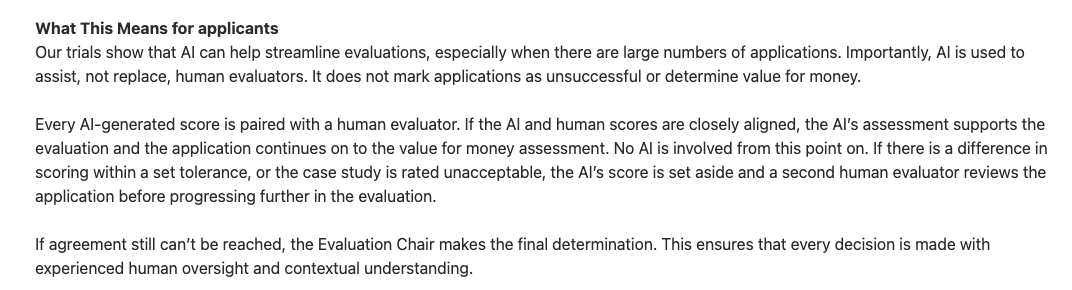
I haven’t come across too many explanations like the above. However, I do know from my tender writing experience in 2025 that there are increasingly tighter restrictions on the format in which you write your response. I had one Victorian Government tender that required red font-only responses without any deviation to the formatting!
SOLOS TO BIG FIRMS
In 2025, I met hundreds of professionals who participate in tenders – from solo tradespersons to multi-national organisations with thousands of staff.
In fact, many of my customers had not used AI at all and were tendering using the exact same approach as they had always done.
Some were wanting to turn a blind eye to embracing the new technology, while others – including professionals in some law firms – were actually prohibited from using it.
Other organisations were in the midst of setting up systems, while others were readily applying them to complete multiple tenders.
FROM PROMPTS TO PLATFORMS
Here’s a brief summary of how TTC customers having been using AI for tenders:
- Smaller businesses are using ChatGPT and Microsoft CoPilot Chat and alike to develop plans and policies, as well as full tender responses. A small business person explained to me recently she used both ChatGPT and Microsoft CoPilot Chat to provide suggested answers to questions after feeding in previously approved company information. She was able to use the best of both to finalise her response.
- SMEs are also using paid versions of ChatGPT and Microsoft CoPilot where the systems leverage existing company information to create content for tenders using a dedicated profile.
- Many bigger companies are developing their own platforms, or already using off-the-shelf platforms to help reduce the complexity and time required to prepare a tender. They upload their organisational content into the system and use this to respond to tender questions. Some systems can even review tender opportunities, analyse the competition and tender requirements, develop template formats for CVs and case studies, and summarise text.
- As a professional tender writer, I continue to be employed to write tenders in mostly the exact same way I have done for the last 20-plus years. I will use AI in tender writing to help with the interpretation of a question or phrase, to assist with research, to summarise key points in a client document and help identify client benefits from key features. I will write more on this in another post.
Regardless of where you are at, or where you are headed, AI is set to revolutionise our industry and hopefully make things more streamlined and efficient.
Feel free to leave your comments below. This blog has only shared to Tender Training College subscribers of this newsletter.
